On the coldest night of the season so far in Charlottesville, a temporary church shelter offered warmth and cots, but Robert Coombs stayed outside. He was aging with mental health challenges, and people who cared about him had been trying to find him a spot at an assisted living facility.
The next morning, Dec. 2, the shelter moved to Trinity Episcopal Church for 14 days, but he did not. Outdoors in the freezing temperatures overnight, he had died.
“Here’s a clear example what the Christian faith is: letting people into your house, no matter how inconvenient and how disruptive that might be, right?” said Trinity Rector Cass Bailey, who supplied information about Coombs. “Because this is what can happen when people don’t come in.”
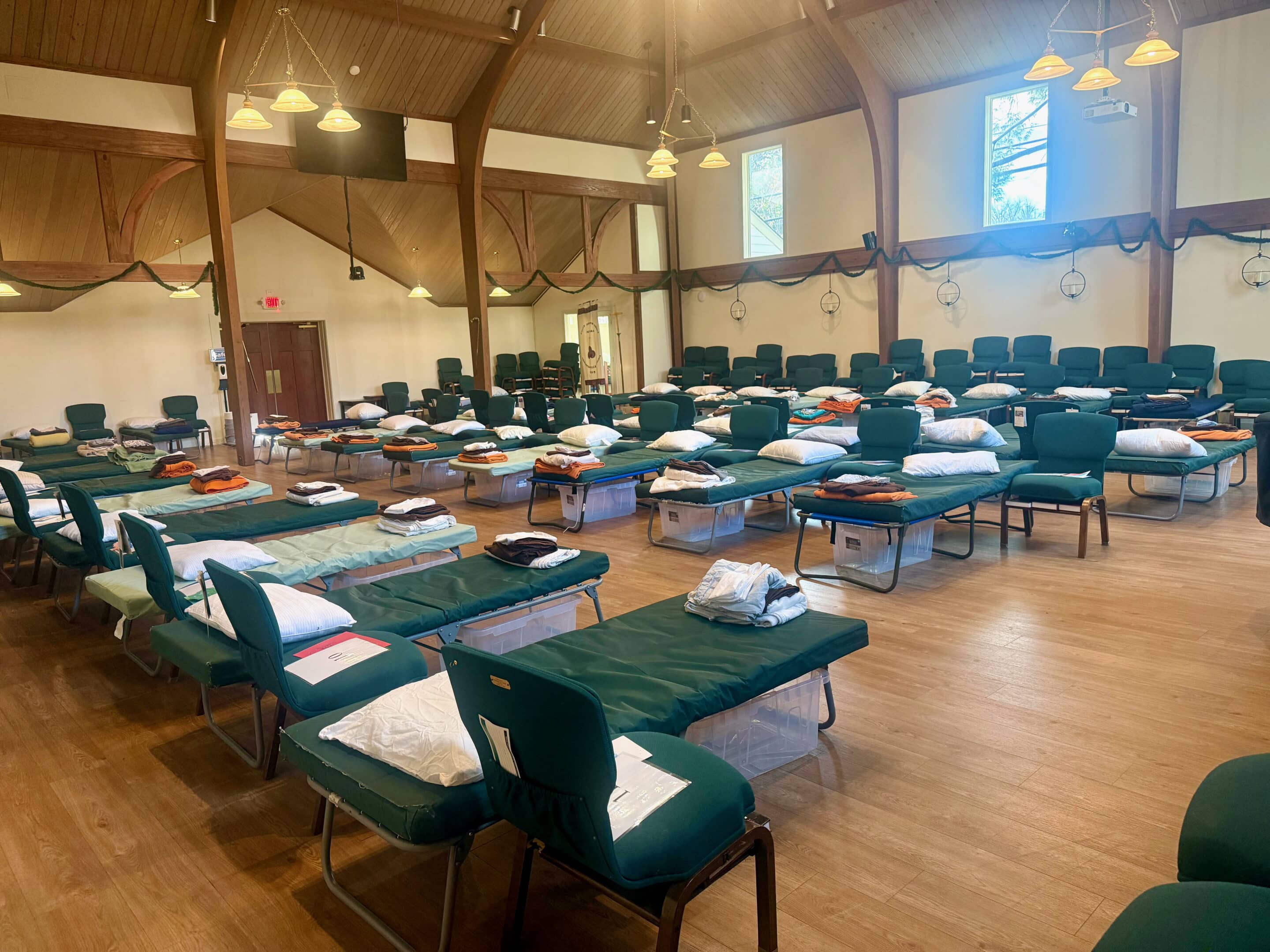
Trinity clears its sanctuary to make room for 40 cots when it hosts the shelter as part of People and Congregations Engaged in Ministry (PACEM). Two decades ago, PACEM started as an emergency response to homelessness in Charlottesville. The city is still working on a permanent response, Bailey said.
Each winter, through PACEM, more than 80 faith congregations and community groups and 3,000 volunteers in the Charlottesville area pitch in to address the need for shelter. They respond by opening their doors, serving evening meals, giving financially, and providing companionship.
Trinity committed to hosting 40 men overnight for 14 days beginning Dec. 2. This effort requires 63 volunteers who each give an average of 4 hours. Also, for the 14 days of the shelter, church volunteers provide nightly dinners for about 60 people (guests, volunteers, and staff).
After Coombs’s death, Bailey said, “We have a renewed sense of urgency.”
Stark Reminder that Shelter Is Essential
On Dec. 1, the temperature in Charlottesville dipped to 28 degrees, with wind gusts up to 21 mph.
Coombs had been staying in PACEM shelter “off and on this season,” PACEM Deputy Director Cindy Preuett Chambers said in an email to staff and volunteers after his death.
But that night, Coombs declined to take a PACEM cot at Ivy Creek United Methodist Church. “He died while sleeping outside at Market Street Park,” Chambers wrote. “We are heartbroken; we carry on the mission.”
“He died while sleeping outside at Market Street Park,” Chambers wrote. “We are heartbroken; we carry on the mission.”
“Winter is fully upon us,” she also noted. “The harsh weather and barren trees are a stark reminder of just how essential shelter is. All research shows that housing is healthcare. It’s a foundational need for a healthy life.”
Nationwide, an annual memorial for people who died while experiencing homelessness —Homeless Persons’ Memorial Day — is traditionally held on the longest night of the year, Dec. 21.
Charlottesville will hold its vigil on Dec. 18 at The Haven, a day shelter and housing resource center. The service will also honor Michael Syrkes Jr., who passed away in his sleep while sheltered by PACEM last month, Chambers said.
“Homelessness can be a death sentence,” Haven Operations Director Ocean Aiello said about the 2024 memorial service. “Homelessness can cut up to 20 years off someone’s life.”
“We have to make that burden bearable”
Trinity provides housing to people who need it; a former parsonage is now home for an Afghan family. In 2026, Trinity will embark on a capital campaign to double the capacity of the Gertrude Mitchell House, a single-family home it owns and operates as transitional housing for women and children who have encountered domestic abuse. With support from fellow Episcopal churches around Charlottesville, Trinity has been able to help women rebuild their families and their futures.
The diocesan mission statement to love Jesus, embody justice, and be disciples “certainly has a bearing on us doing this work,” said Bailey, the rector since 2010.
Established as a Diocesan mission in 1919, Trinity has a long history of serving the community.
“We live out our vision through our ministries,” the Trinity website notes. “Every day, we seek to live more fully into our vision of Trinity as a community of reconciliation, transformation, and love.”
While hosting the PACEM shelter, the Trinity congregation will celebrate Advent 2 and most of Advent 3 services in the much smaller parish hall.
“It’s a huge disruption of our way of being from week to week, there’s all the volunteer hours, and what struck me is that despite the disruption and labor, here’s what happens if you sit on the sidelines and don’t get involved in some way, any way,” Bailey said. “There are real-world consequences.”
Trinity gets help from a nearby Friends Meeting House (Quakers) that does not have shelter space, so they donate volunteers.
“If other churches are on the fence about sheltering people, or they can’t host themselves, maybe they can partner with another church,” Bailey said. “We have to make that burden bearable, of housing those who do not have housing.”